Sea fishing permit in Croatia 2026
 A short introduction: since 1999 Blufishing.com has kept its readers constantly up to date on the news and the laws governing the issue and purchase of the Sea Fishing Permit in Croatia and Sport Fishing at Sea in Croatia. What you will read on this page has been copied several times, with gross errors, on other sites. Blufishing.com leaves the conclusions to you and wishes you a good read.
In this video you will find an in-depth look at fishing in Croatia, made by F.I.P.I.A. with my collaboration (the video predates the 2026 changes): https://www.youtube.com/watch?v=Xrj0lIuSoSw
Page last updated: 20/10/2026
On this page: News 2026 · Recreational permit · Sport permit (spearfishing) · Prices · Minimum sizes and closed seasons
NEWS 2026: THE NEW SEA FISHING REGULATION
Since 1 June 2026 the new Croatian Regulation on sport and recreational fishing at sea has been in force (Pravilnik, Narodne novine 48/2026), replacing the previous one. The changes arrive in stages, up to 2030. Here are those that concern anglers fishing in Croatia, with the dates.
Immediately
– New prices: daily €10, 3 days €25, 7 days €45. All the prices are in the table at the bottom of the page.
– The permit must be bought before fishing, no longer on the spot at the time of a check. It is personal and non-transferable. The daily permit is valid for 24 hours, the 3-day permit for 72 hours and the 7-day permit for 168 hours, and it starts at least one hour after purchase.
– Species whose catch is prohibited (Annex 1, table 3): sharks, rays and all other cartilaginous fish (including smooth-hounds and spiny dogfish), Atlantic bluefin tuna, swordfish, Mediterranean spearfish, albacore, eel, large crustaceans, echinoderms, corals and sponges. If you catch one by accident, it must be released alive and unharmed, whenever possible even before pulling it out of the water. For sharks and rays the daily limit is 0 (art. 11, paragraph 4). Bluefin tuna is an exception only for the “trophy catch” and for competitions with an assigned quota.
– Also to be released are undersized specimens, those caught during a closed season and those exceeding the catch limits (art. 8, paragraph 11). Minimum sizes and closed seasons are in the list at the bottom of the page.
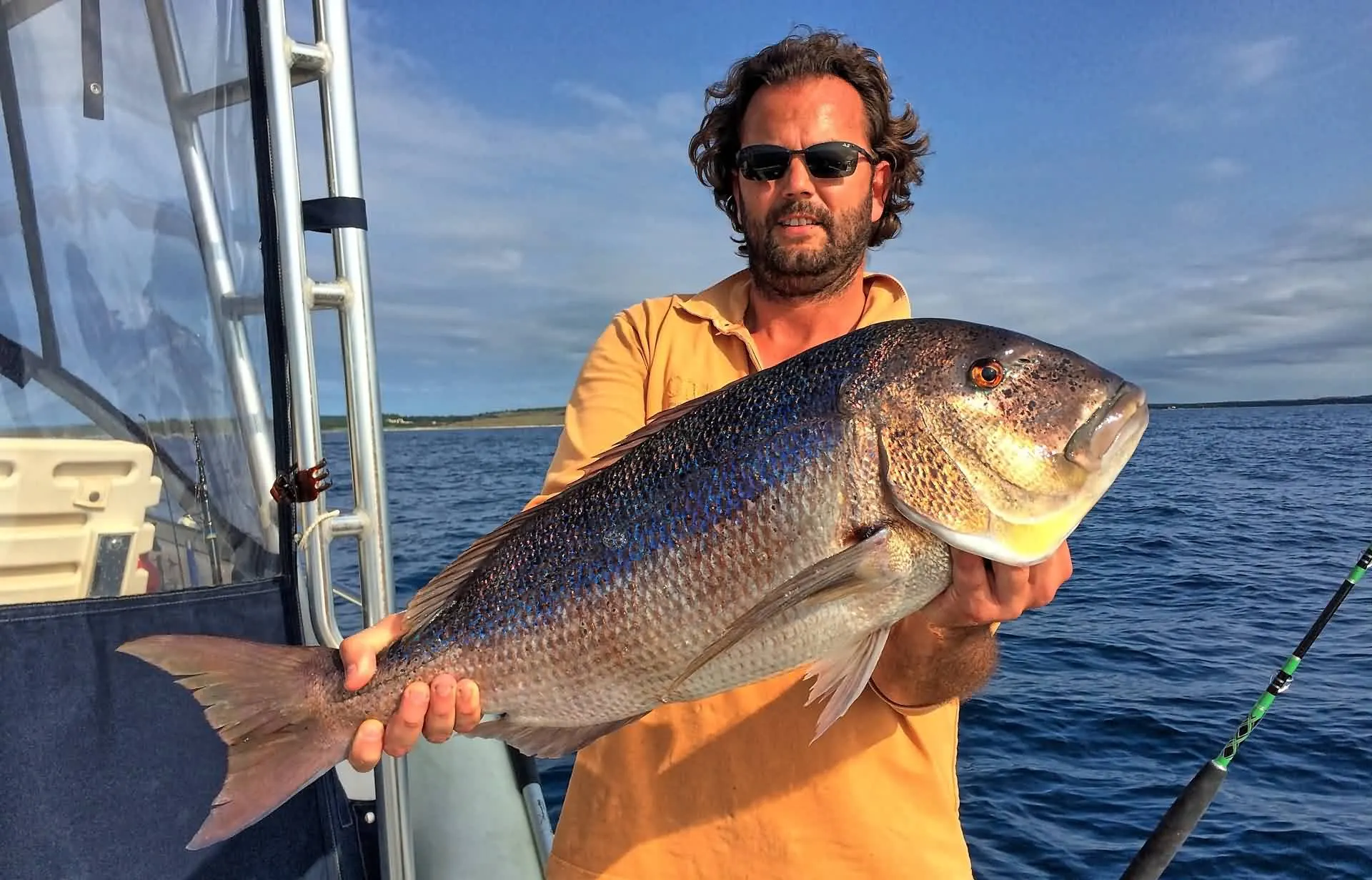
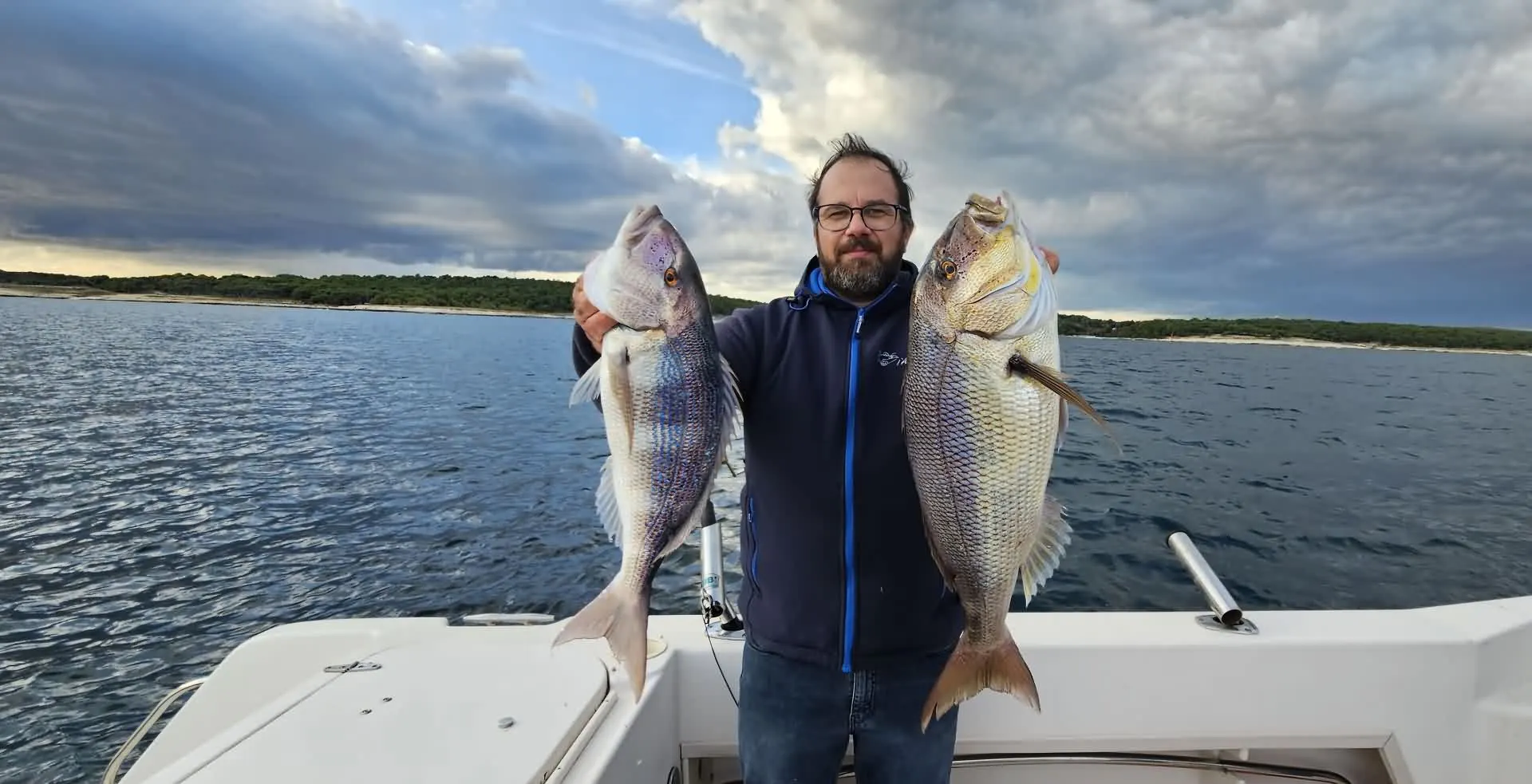
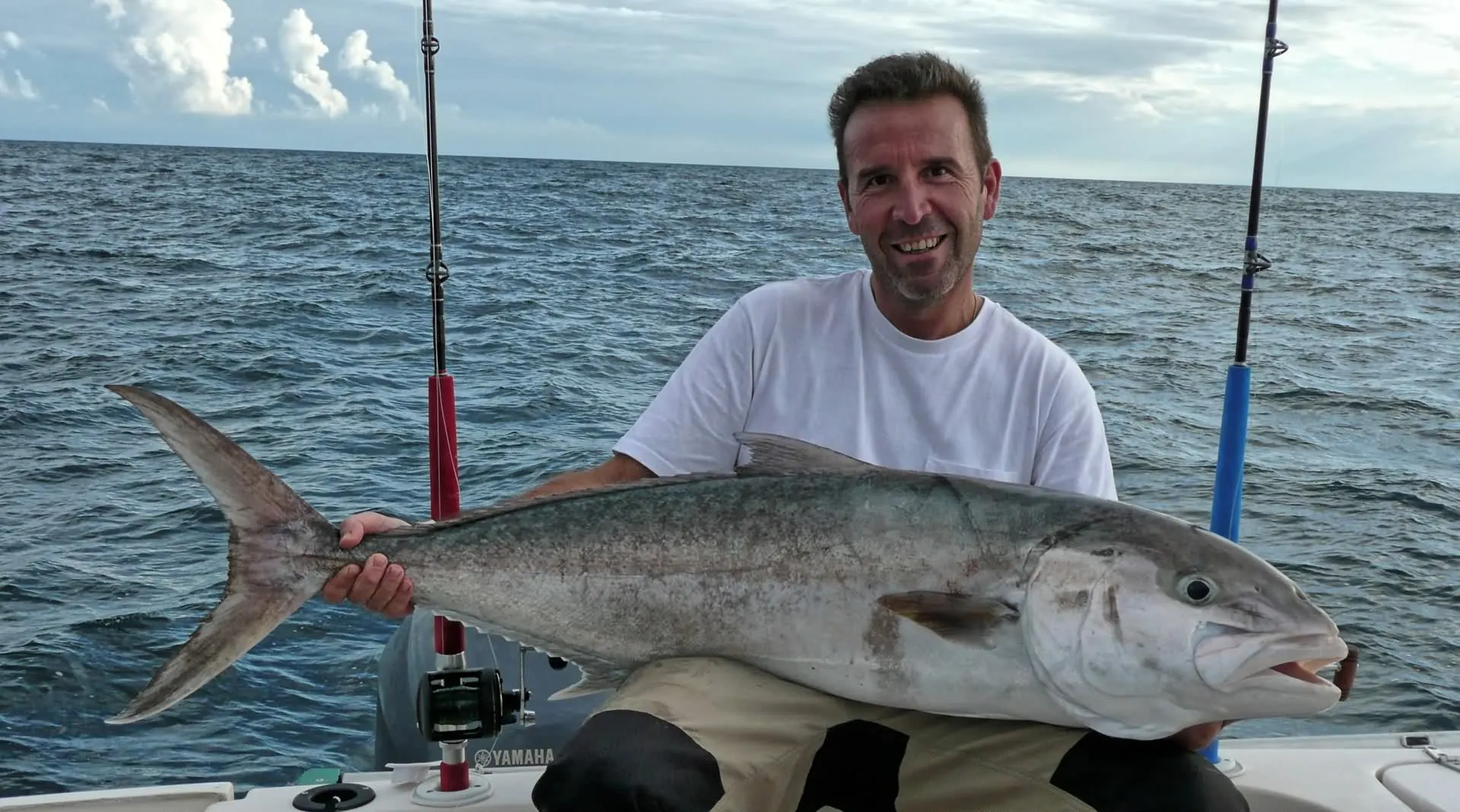
– Marking of the catch: the fish you keep must be marked immediately by cutting the lower part of the tail fin. There are 23 species: common dolphinfish, common dentex, pink dentex, sea bass, sharpsnout seabream, white seabream, common two-banded seabream, groupers (Epinephelus spp., Mycteroperca rubra and wreckfish), brown wrasse, cuckoo wrasse (Labrus mixtus), striped seabream, European hake, common pandora, red porgy, Atlantic bonito, brown meagre, greater amberjack, red scorpionfish, gilthead bream, black seabream and John Dory. Cephalopods you keep (octopus, squid, cuttlefish…) must be marked with a deep cut on the head, between the eyes; the exceptions are squid (Loligo vulgaris) and cuttlefish (Sepia officinalis) used as live bait.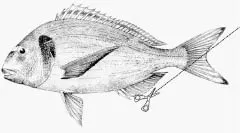
– Limits for each fishing day: at most 2 octopuses, 1 grouper in total (Epinephelus spp., wreckfish and Mycteroperca rubra) and 2 large sea worms (Eunice roussaei). Live bivalve molluscs and gastropods: up to 2 kg, mussels up to 5 kg. The maximum catch per angler is set by the marine fisheries law (art. 8, paragraph 1): once reached, you cannot keep fishing. The rule described below (5 kg and the exception) remains.
– Other bans: selling the catch; collecting marine organisms with scuba tanks; fishing by “rampinavanje”, that is with a multiple hook cast to snag the fish from outside its body (the text does not generally address treble hooks on artificial lures); using artificial light with cephalopod lines from 1 March to 30 September. Electric reels or winches up to 800 W are allowed.
– Protected areas (national parks, special reserves, nature parks): the ordinary permit is not enough, you need a special permit sold by the body that manages the area, which also sets its price. The Ministry can ban fishing or add limits.
– Big game fishing: with a rod and reel of at least 30 lb you need the sport permit plus a special big game permit, with at most 2 rods with reels. Hooks must be circle hooks and not made of stainless steel; with artificial lures the classic single-point hook (J) is allowed.
From 15 August 2026
– Dolphinfish: every catch must be recorded with the mRecFish app, with any permit, within 24 hours of the end of fishing. Dolphinfish fishing is prohibited from 1 January to 14 August every year and the minimum size is 35 cm (NN 134/2024).
From 1 January 2027
– mRecFish app and catch log (gear used, fishing areas, quantities kept, fish released): mandatory with the 1-, 3- and 7-day permits and with the 150-day and annual permits of adults up to 65 years old.
– Price increase for the 150-day, annual and special permits.
From 1 January 2030
– The mRecFish obligation extends to the other holders of 150-day and annual permits (minors, pensioners and over-65s).
To check before you go
– Small harbours, harbours and public beaches: fishing is banned from 1 May to 1 October, so only in the summer period. This rule does not appear in the text of the Regulation: ask locally before fishing from piers and beaches.
– 5-day permit: it does not exist. After the 3-day permit comes the 7-day permit at €45.
– Baits: it is not clear whether the “large sea worm” (Eunice roussaei), limited to 2 per day, is the “Rimini worm”, or whether the limit also applies to purchased bait. The limit of 20 cm of mantle for squid used as live bait, in force since 2018, does not appear in the new text.
– Minimum sizes and closed seasons: those at the bottom of the page come from the Pravilnik NN 64/2023 as amended by NN 134/2024, the latest that I can find. Before you go, check that there are no more recent ones.
Sources: Narodne novine 48/2026 (Regulation on sport and recreational fishing at sea); NN 64/2023 and NN 134/2024 (minimum sizes and closed seasons).
To fish in Croatia (from the shore, from a boat or freediving) you need a fishing permit, valid along the whole coast of the Republic of Croatia, except protected areas (national parks, special reserves and nature parks, for example Mljet and the Kornati), where you need a special permit from the park authority (see “News 2026”).
There are two sea fishing permits for Croatia:
1 – RECREATIONAL FISHING PERMIT FOR CROATIA →NO SPEARFISHING←
This permit allows you to fish, even at the same time, with:
– up to 2 rods (odmet)
– up to 2 handlines (kančenica)
– up to 2 trolling lines (panula)
– up to 2 cephalopod lines (povraz), each with at most 3 baits or hooks
– up to 2 tools for the large sea worm (trapula)
– hand collecting of marine organisms, with or without hand tools
Anyone can get the recreational permit: it is bought at tourist offices and other authorised sellers, or online (see below). With the recreational permit spearfishing is NOT allowed!
2 – SPORT FISHING PERMIT FOR CROATIA – FOR SPEARFISHERS
This permit allows you to fish, even at the same time, with the same gear as the recreational permit (see above) and also with:
– 2 SPEARGUNS (the limits of spearfishing are set by the marine fisheries law; the Regulation prohibits being towed by the boat and using an underwater scooter)
The Sport Fishing Permit is bought from the sport fishing associations of the Croatian Federation, stating the membership card number (F.I.P.I.A. or Croatian Sport Fishing Federation) when requested. Anyone without a card can get the Federation's card online, at the permit purchase address, by selecting the option “I don’t have valid annual membership card”, at a cost of €2.00 for minors and €10.00 for adults. On that site only the 1-, 3- and 7-day sport permits can be bought online. The 150-day permit (on sale from 2 March to 30 November) and the annual permit (from 1 December to 1 March) are bought from the Federation's associations.
→ When you buy the Sport Fishing Permit on Sub.hr, the payment already includes the annual fee to the national Sport Fishing association of the Republic of Croatia and the membership fee to their club.
I strongly recommend that anyone without an F.I.P.I.A. card buys it on Sub.hr!
→ Protected areas: to fish, for example, in the Lastovo Islands Nature Park you need a special permit, issued by the Ministry and sold by the body that manages the park (see “News 2026”).
The maximum quantities shown apply to each type of gear and can be used at the same time (art. 7, paragraph 1 of the Regulation).
There is still other important information on sport fishing, in particular:
– Big game fishing (rod and reel of at least 30 lb, art. 3 point 8) requires the sport permit plus the special big game permit, whose prices are in the table at the end of the page.
– The maximum number of tools is two (2) of each type; cephalopod lines have at most 3 baits or hooks each. Be careful, this detail is not to be underestimated, because no excuses of any kind are tolerated.
– Atlantic bluefin tuna, swordfish, Mediterranean spearfish and albacore are species whose catch is prohibited (Annex 1, table 3). One caught by accident must be released alive and unharmed before pulling it out of the water. Bluefin tuna is an exception only for the “trophy catch” and for competitions with an assigned quota (art. 8, paragraph 13).
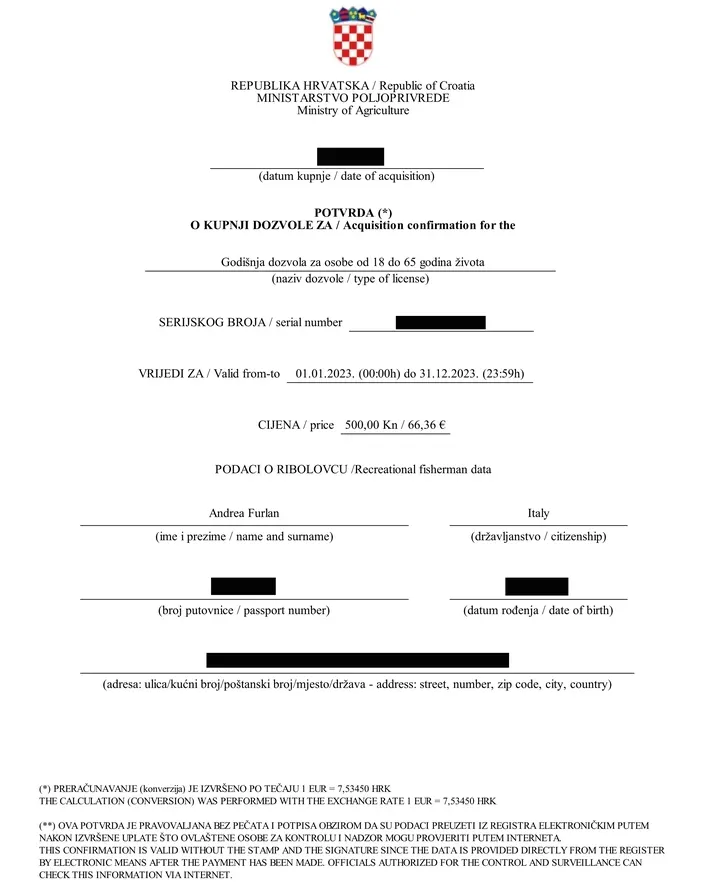
The Croatian fishing permit is personal and non-transferable! The purchase confirmation shows the FIRST NAME and SURNAME of the angler, the document number provided at the time of purchase (identity card or passport), the date of birth and the address of residence. The travel document (always required, even though Croatia now fully belongs to the Schengen area) must be the same one shown on the fishing permit and must be shown, together with the permit, in case of a check by the competent authorities. They are:
- the Police (Policija)
- the Coast Guard (Lučka Kapetanija)
- the Fisheries Inspection (Ribarska Inspekcija)
You do not need to print a permit bought online: just show the PDF that arrives by e-mail, because it contains a serial number that the authorities can easily check. I strongly recommend saving it on your smartphone.
The maximum daily quantity of fish remains unchanged: 5 kg per person, plus the exception.
The permit is easy to find on site: almost all the tourist offices on the coast can issue it. This is the official (.xlsx) file from the Croatian Ministry with the list of authorised sellers: List of authorised sellers
→ IT IS NOT POSSIBLE TO BUY THE CROATIAN RECREATIONAL FISHING PERMIT THROUGH BLUFISHING.COM ←
It can be bought online only at this address or on Sub.hr
→ IT IS NOT POSSIBLE TO BUY THE CROATIAN SPORT FISHING PERMIT THROUGH BLUFISHING.COM ←
The sport permit is bought from the Federation's associations, for example on Sub.hr. On the website of the Croatian Ministry only the 1-, 3- and 7-day sport permits can be bought online.
Other rules
– The monthly permit no longer exists.
– The annual recreational permit can be bought online only by 1 March of the current year, or at authorised Croatian travel agencies (List of authorised sellers).
– There is a recreational and sport permit for 150 days.
– The annual permit for “pensioners” applies from age 65 (previously 60). Annual permits for pensioners under 65 and for Croatian war invalids can only be bought in person, at the Ministry or from authorised sellers.
– With equipment of 30 lb or more (rod or reel) you need the sport permit plus the special big game permit.
– Marking of the catch: the rules have changed, see “News 2026” above.
PRICES OF THE SEA FISHING PERMIT IN CROATIA (in euro, valid from 1 June 2026)
| PERMIT DURATION AND AGE | RECREATIONAL PERMIT PRICE | SPORT PERMIT PRICE |
| 1 DAY | €10 | €10 |
| 3 DAYS | €25 | €25 |
| 7 DAYS | €45 | €45 |
| 150-DAY PERMIT FOR YOUNG PEOPLE UP TO 18 YEARS OLD | €13.27 | €1.33 |
| 150-DAY PERMIT FOR PEOPLE AGED BETWEEN 18 AND 65 | €99.54 | €79.63 |
| 150-DAY PERMIT FOR PEOPLE OVER 65 | €13.27 | €7.96 |
| ANNUAL PERMIT FOR YOUNG PEOPLE UP TO 18 YEARS OLD | €13.27 | €1.33 |
| ANNUAL PERMIT FOR PEOPLE AGED BETWEEN 18 AND 65 | €66.36 | €46.45 |
| ANNUAL PERMIT FOR PEOPLE OVER 65 | €13.27 | €7.96 |
| OFFSHORE (BIG GAME) FISHING PERMIT FOR 1 DAY | NOT AVAILABLE | €15.93 |
| OFFSHORE (BIG GAME) FISHING PERMIT FOR 3 DAYS | NOT AVAILABLE | €39.82 |
| OFFSHORE (BIG GAME) FISHING PERMIT FOR 7 DAYS | NOT AVAILABLE | €79.63 |
| OFFSHORE (BIG GAME) FISHING PERMIT, ANNUAL | NOT AVAILABLE | €92.91 |
* The 150-day permit is bought from 2 March to 30 November, the annual one from 1 December to 1 March. For over-65s resident on the islands and on Pelješac the recreational 150-day and annual permit is free. The big game permit is added to the sport one and must cover the whole period. There are also special annual permits for fixed longlines and fish traps (€26.54), for fish spears and for artificial light (€13.27).
MINIMUM SIZES AND CLOSED SEASONS (Pravilnik NN 64/2023, as amended by NN 134/2024)
| SPECIES | CROATIAN NAME | MINIMUM SIZE | CLOSED SEASON AND NOTES |
| Common dentex (Dentex dentex) | zubatac | 30 cm | |
| Sea bass (Dicentrarchus labrax) | lubin, brancin | 25 cm | |
| Annular seabream (Diplodus annularis) | špar | 12 cm | |
| Sharpsnout seabream (Diplodus puntazzo) | pic | 18 cm | |
| White seabream (Diplodus sargus) | šarag | 23 cm | |
| Common two-banded seabream (Diplodus vulgaris) | fratar | 18 cm | |
| European anchovy (Engraulis encrasicolus) | inćun | 9 cm | |
| Groupers (Epinephelus spp.) and wreckfish (Polyprion americanus) | kirnje, kirnja glavulja | 45 cm | closed season from 1 July to 31 August (also applies to Mycteroperca rubra); at most 1 grouper per day, in total |
| Common dolphinfish (Coryphaena hippurus) | lampuga | 35 cm | fishing prohibited from 1 January to 14 August |
| Striped seabream (Lithognathus mormyrus) | ovčica | 20 cm | |
| European hake (Merluccius merluccius) | oslić | 20 cm | |
| Red mullets (Mullus spp.) | trlje | 11 cm | |
| Axillary seabream (Pagellus acarne) | batoglavac | 17 cm | |
| Blackspot seabream (Pagellus bogaraveo) | okan, rumenac | 33 cm | |
| Common pandora (Pagellus erythrinus) | arbun | 15 cm | |
| Red porgy (Pagrus pagrus) | pagar | 18 cm | |
| Atlantic bonito (Sarda sarda) | palamida | 40 cm | |
| European pilchard (Sardina pilchardus) | srdela | 11 cm | |
| Brown meagre (Sciaena umbra) | kavala | 30 cm | closed season from 15 May to 15 July |
| Atlantic mackerel (Scomber scombrus) | skuša | 18 cm | |
| Atlantic chub mackerel (Scomber colias) | plavica, lokarda | 18 cm | |
| Red scorpionfish (Scorpaena scrofa) | škrpina | 25 cm | |
| Greater amberjack (Seriola dumerili) | gof | 35 cm | was 45 cm, reduced in 2024 |
| Common sole (Solea solea) | list | 20 cm | |
| Gilthead bream (Sparus aurata) | komarča, orada, podlanica | 20 cm | |
| Black seabream (Spondyliosoma cantharus) | kantar | 18 cm | |
| Horse mackerels (Trachurus spp.) | šaruni | 15 cm | |
| European eel (Anguilla anguilla) | jegulja | 35 cm | closed season from 1 March to 31 October. In sport and recreational fishing, catching it is prohibited |
| Swordfish (Xiphias gladius) | iglun, sabljarka | 11.4 kg whole, 10.2 kg gutted or 100 cm (fork length) | closed season from 1 January to 31 March. In sport and recreational fishing, catching it is prohibited |
| Atlantic bluefin tuna (Thunnus thynnus) | plavoperajna tuna | 30 kg whole, 26.5 kg gutted or 115 cm (fork length) | catch prohibited, except for the “trophy catch” and competitions with an assigned quota |
| Albacore (Thunnus alalunga) | albakor, dugokrila tuna | not specified | closed season from 1 to 31 March and from 1 October to 30 November. In sport and recreational fishing, catching it is prohibited |
The Regulation refers to this rule for minimum sizes and closed seasons (art. 8, paragraph 2). Sizes are measured as indicated in Annex IV of EU Regulation 2019/1241 (art. 4). Undersized specimens, or those caught during a closed season, must be released (art. 8, paragraph 11 of the Regulation on sport and recreational fishing). In red, the species whose catch is prohibited in sport and recreational fishing. Other organisms: common octopus (Octopus vulgaris) 1 kg, at most 2 per day; European flat oyster (Ostrea edulis) 7 cm; Mediterranean scallop (Pecten jacobaeus) 10 cm; clams (Chamelea gallina, Ruditapes spp., Venus spp.) 25 mm. Catching large crustaceans (spiny lobster, European lobster, spiny spider crab, slipper lobster), echinoderms (sea urchins, sea cucumbers, starfish), corals and sponges is prohibited.